
Set It and Forget It: How to Install a Drip Irrigation System for Your Raised Beds
Watering your garden by hand isn't bad. But it's inconsistent, time-consuming, and easy to skip when life gets busy — and your plants feel every missed day. A properly installed drip irrigation system solves all of that. It delivers water directly to the roots (rather than the leaves, decreasing risk of disease), keeps the soil moisture steady, and runs on a timer whether you're home or not.
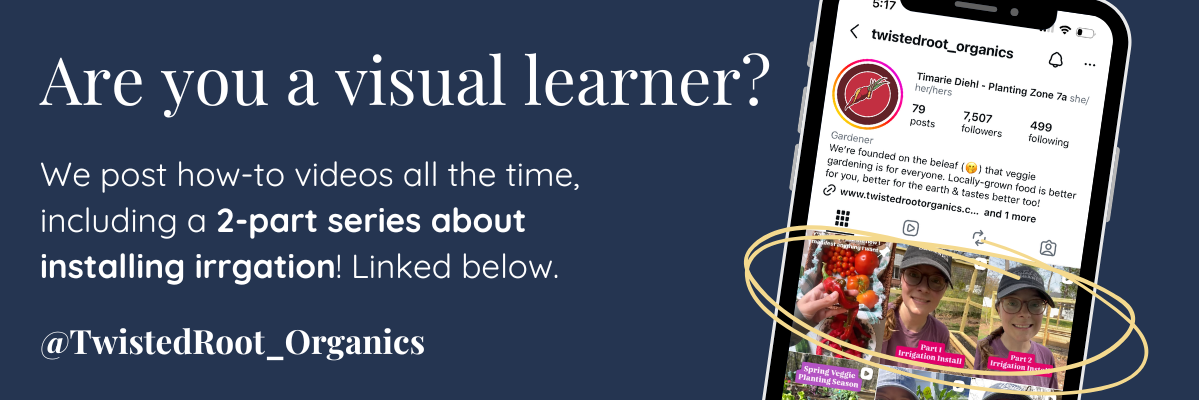
This post walks through exactly how we set up drip irrigation at client properties. It's the same system we install across our raised bed builds, and once it's in, most clients barely think about watering again. Also, peep the ✨Irrigation Shopping List✨ at the bottom of this post!
Why Drip Irrigation (Not Overhead Spray)
A lot of gardeners default to overhead watering — a hose, a sprinkler, a spray head. It works, but it has real downsides for vegetable beds:
Wet foliage invites fungal disease. Tomatoes, squash, and cucumbers are especially susceptible to issues like powdery mildew and early blight, and overhead watering contributes directly to those problems.
Water lands where you don't need it — on pathways, on mulch, on leaves — instead of at the root zone where it actually matters.
Sunlight hitting water droplets on leaves can cause sunscald, especially on hot afternoons.
It's hard to water consistently. Hand-watering schedules drift, and plants notice.
Drip solves all of this. Water goes underground, directly to the roots. Foliage stays dry. Soil moisture stays consistent. And once it's on a timer, you're not thinking about it anymore.
What You Need Before You Start
Before you buy anything, walk your setup and answer these questions:
How many beds are you watering, and how far are they from the spigot?
Do you have one spigot serving multiple zones, or just one?
Where are people walking most? You want to route tubing where it won't get stepped on or kicked.
Where is the system most visible from your main outdoor area? Plan to keep that side clean.
The goal is a system that looks intentional — tubing staked low and tight to the bed edges, out of sight lines from where you actually spend time outside. A messy irrigation setup detracts from the oasis that is your vegetable garden.
Rule #1: Always Start From the Spigot
This is the single biggest mistake DIYers make — buying components and trying to work backward from the garden. Build from the water source outward, every time.
At the spigot, your assembly (in order) looks like this:
Vacuum breaker / anti-siphon device — protects your home's water supply from backflow contamination. Required by code in most municipalities and worth doing regardless.
Faucet splitter — lets you run irrigation on one side while keeping a regular hose connection available on the other.
Digital timer with rain sensor — set your schedule and let it run. The rain sensor skips watering cycles when it's not needed, which saves water and prevents overwatering.
Pressure regulator (25 PSI) — drip systems are low-pressure by design. Your house water pressure is likely 45–80 PSI. Without a regulator, you'll blow fittings and blow out emitters. Step this down to 25 PSI before anything else.
1/2" female hose thread swivel (FHTS) adapter — this transitions from your threaded spigot assembly to the 1/2" poly tubing that runs through the yard.
Get all of that assembled and working before you run a single inch of tubing. Turn the water on, check for leaks, confirm the timer is cycling. Once the spigot assembly is solid, everything downstream is easy.
Running the Main Line
Your 1/2" polyethylene tubing is the backbone of the system. It runs from the spigot to the beds and doesn't deliver water itself — it's just a distribution line.
A few things to keep in mind when routing it:
Run it along fence lines, bed edges, or structures — not across open walkways.
Think about where you step most when you're in the garden. Route the line through low-traffic zones.
The least visible side of the bed from your outdoor seating or back door is where you want the main line to travel. Keep the visible side clean.
Stake it down every 18–24 inches with galvanized wire stakes. Loose tubing looks sloppy and gets tripped on.
Use Perma-Loc elbows at corners — they connect without tools and hold securely. Perma-Loc couplings join straight runs if you're connecting multiple lengths.
End each main line run with a Perma-Loc end cap. Don't leave it open.
Into the Beds: The 1/4" Dripline
Once your 1/2" main line is in place, you branch into the beds using 1/4" barb tees to tap the main line and run 1/4" dripline across the soil surface inside each bed.
We use 1/4" dripline with 6" emitter spacing at 0.5 GPH. For a standard 4x8 raised bed, three or four parallel runs of dripline across the bed width gives you good coverage without overloading any one section.
A few pointers for inside the bed:
Run the dripline below or just at the soil surface. You can press it in slightly or cover lightly with soil or mulch. This keeps it out of the way during planting and harvesting.
Keep emitters pointed down — they're watering roots, not air.
Use 1/4" barb elbows to turn corners cleanly inside the bed.
Cap or goof-plug any unused 1/4" ports. Always order extra goof plugs — you'll use them.
If a dripline gets punctured or kinked, goof plugs are also your fix. Punch a new hole nearby, insert a new barb fitting, and move on.
Timer Settings: What to Start With
There's no universal answer here because soil type, bed size, sun exposure, and season all affect how much water your garden needs. But a reasonable starting point for most raised beds in the Northeast:
Frequency: daily watering during the growing season (May through September)
Duration: 60-90 minutes per zone at 0.5 GPH emitter flow
Time of day: early morning is ideal — soil absorbs water before the heat of the day, and any surface moisture dries before evening
Watch your beds for the first week. Stick a finger in to the second knuckle. If the top inch of soil is consistently wet by late afternoon, dial back the duration. If plants are wilting by midday, increase it. Raised beds dry out faster than in-ground gardens — especially in full sun — so err on the side of slightly more water until you know your beds.
The rain sensor takes care of days when nature does the watering for you.
Quick Tips for a Clean Installation
Warm the tubing before bending. Cold 1/2" poly is stiff and wants to kink. Let it sit in the sun for 20 minutes or run warm water through it — it becomes much easier to work with.
Lay out your full run on the ground before staking anything. This lets you adjust routing without pulling stakes.
Label your timer zones if you're running multiple. A small piece of tape with a marker on the timer face saves a lot of confusion mid-season.
Check fittings at the start of each season. Freeze-thaw cycles can loosen connections over winter.
Blow out or drain the system before the first hard frost. Pull the timer inside — they don't love freezing temperatures.
What We Use
We source almost everything from Drip Depot. Their parts are consistent, they stock everything in compatible sizes, and the pricing is straightforward. For the raised beds themselves, we usually use EarthEasy cedar raised bed kits — well-built, clean-looking, and made from naturally rot-resistant cedar.
Shopping List
I purchase all my irrigation supplies from Drip Depot, and have pulled together a PDF of all the parts you should need for a standard one-zone drip setup serving one or more raised beds. Adjust tubing quantities based on your layout.
And, if you loved the raised beds shown in the video, those are my favorite Earth Easy 8×3’ beds, 22” height. So easy to set up, all natural cedar, cannot recommend them enough.