What a Kid Taught Me About Soil Prep (And Why It’s the Most Important Thing You’ll Do All Season)
I’ll be honest—soil prep day is not exactly a crowd-pleaser.
No seeds going in the ground. No harvest to show off. Just you, a pile of compost, and a rake. It’s the behind-the-scenes work of gardening—the stuff that doesn’t make it onto anyone’s Instagram feed.
So I was genuinely surprised recently when, mid-prep at a client’s house, two of her kids wandered outside… and stayed. Not for five minutes. Not for a polite amount of time before getting bored. They grabbed rakes and actually helped.
Kids, in my experience, are into planting. They love dropping seeds into soil, watching something sprout, and especially picking fruit straight off the vine and eating them before anyone can object. Soil prep? That’s usually a hard sell.
Eventually, curiosity got the better of me. I asked them, “Do you guys actually enjoy doing this type of work?”
The older one didn’t miss a beat. “Not really… but if we do this now, the tomatoes will grow better, and we’ll have enough for mom and dad’s homemade tomato sauce, and we all get to eat it together.”
I stood there for a second, rake in hand, genuinely moved.
That's it. That's the whole thing…
That's why I do this work: to help people grow food that makes its way to the dinner table, that turns into a shared meal, that means something. And this kid got it without me having to explain anything. He understood, at whatever age he was, that the boring prep work now is what makes the homemade summer tomato sauce possible.
There's something quietly powerful about that connection between the work you put into the space and the environment, and the food that ends up on your plate. It's easy to lose sight of where food actually comes from when it's always just... there and available. Growing even a little of it yourself has a way of changing that. You notice things differently. A tomato you grew tastes better—partly because it actually is better, and partly because you know what went into it.
That's what a garden does, over time. It closes the loop.
So. Let’s talk about soil prep.
Why Soil Prep Matters More Than Almost Anything Else
Here’s the thing about plants: they grow where they are sown. They can’t compensate for a bad environment by trying harder. Whatever is in the soil when you plant is largely what they have to work with for the entire growing season.
Soil isn’t just dirt. It’s a living system full of bacteria, fungi, earthworms, and billions of microscopic organisms that break down organic matter into the nutrients your plants absorb. When that system is healthy, plants thrive. When it’s depleted, compacted, or nutritionally bankrupt, you can have the best sun exposure and water all you want, but the plants will still struggle. Soil is the foundation of it all.
Beginning-of-season soil prep is your one big window to set things up right before the growing season starts. It’s significantly harder (and less effective) to correct soil problems once plants are in the ground.
What to Actually Put in Your Beds
Not all soil products are created equal, and the labeling at garden centers can be confusing. Here’s a practical breakdown:
Compost: Replenishing Nutrients
Finished compost is the single most valuable thing you can add to a garden bed. It improves drainage in clay-heavy soils, helps sandy soils retain moisture, feeds the microbial life that makes nutrients available to plants, and slowly releases nutrition over the entire season.
For most home gardens, aim to top-dress or mix in 2–3 inches of compost at the start of the season. Look for compost that smells earthy (not sour or ammonia-like), has a dark color, and has a crumbly texture. If you can make your own from kitchen scraps and yard waste, even better.
How to choose your compost:
But make sure that the ingredients that went into your compost are varied. Often Mushroom Compost has the highest nutrient density, but compost that was primarily created from leaf mold won’t do the trick for your vegetable gardens. Call your garden center and ask them what was used to create their compost, anywhere that’s making good quality stuff will be happy to talk about it.
Topsoil: Use It Carefully
Topsoil is useful when you’re building a new raised bed from scratch or filling significant volume. But it’s not a substitute for compost—it brings the bulk without very much biological activity. Quality varies wildly by supplier, so if you’re buying in volume, ask what’s in it. If it’s black soil vs. very brown, you’re probably on the right track.
To fill a new raised beds, a good starting mix is roughly 60% topsoil / 30% compost / 10% perlite or coarse sand (for drainage). For established in-ground beds, you probably don’t need additional topsoil at all, just compost.
But top off an established bed, you are predominantly replenishing the nutrients that were used the previous year by the plants, so you want to use a minimum of 60-70% compost.
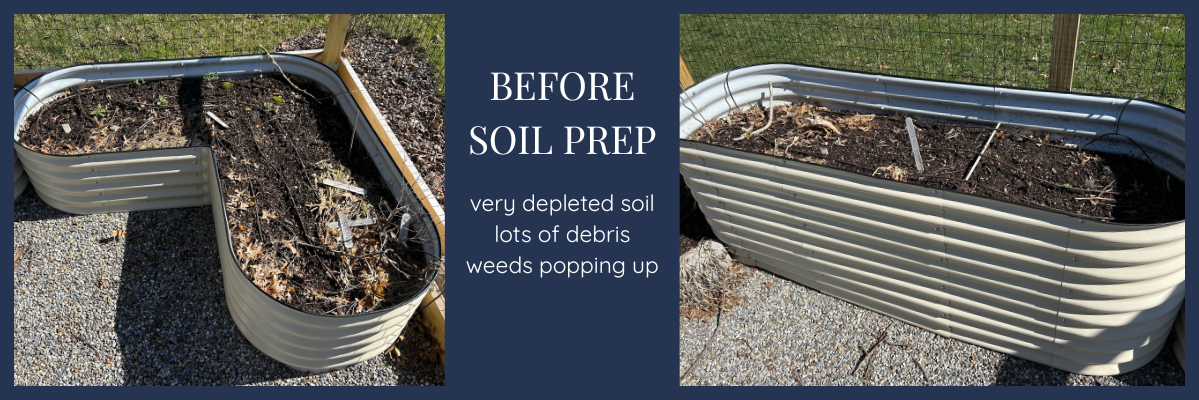
Soil Amendments: The Fine-Tuning Layer
Amendments are targeted additions that address specific deficiencies or improve soil structure. I personally rely on my quality Mushroom Compost mix, specifically purchased from Country Mile Gardens, to get all the extra nutrients I need. And then throughout the growing season I use organic concentrates (fish fertilizer and Big Bloom) at different stages of the growing process, to boost the specific nutrients that the plant needs to create either a healthy plant structure (fish fertilizer, which is high in nitrogen), or an abundance of flowers (Big Bloom, which is high in potassium and phosphorous).
However, it’s worth mentioning amendments during the soil prep discussion as well. The most useful ones for home vegetable gardens:
Granular organic fertilizer (balanced NPK): A slow-release source of nitrogen, phosphorus, and potassium. Work it into the top few inches before planting. Follow package rates—more is not better here.
Lime (if your soil is acidic): Most vegetables prefer a pH of 6.0–7.0. If your soil is below that, lime helps bring it up. You won’t know without a soil test, which is worth doing every few years.
Worm castings: Gentle, microbially rich, and hard to over-apply. Great for transplants or mixing into seed-starting areas.
Biochar or perlite: Both improve drainage and aeration. Useful in heavy clay soils or in raised beds that tend to stay waterlogged.
How to Actually Do It (The Short Version)
Clear out any dead plant material or weeds from last season.
Loosen the top few inches of soil with a broadfork or garden fork. Don’t go overboard—you’re aerating, not tilling, which affects the soil structure and life underground.
Add 2–3 inches of compost across the surface (or add the top soil as a base layer before the compost.)
Incorporate any amendments (fertilizer, lime, etc.) and rake everything level.
Water lightly to help it all settle in, and let the bed rest for a few days before planting if you can.
That’s it. No magic. No expensive products required. Just doing the foundational work before you ask anything of the soil, or the plants!
The Part That’s Actually About the Tomatoes
Of course soil science can get very… well, scientific and existential, but there’s also a simple way to consider this step, just as our friend so matter-of-factly explained. He didn’t say anything about nitrogen cycles or soil pH or microbial diversity. He said: if we do this now, we’ll all get to eat together all summer.
The science matters. Understanding your soil matters. But at the end of the day, all of it is in service of something much simpler: growing food that ends up on a table, shared with people you love.
Prep your beds well this spring. The tomatoes (and whoever eats them) will thank you.
Have questions about your specific soil situation? Or want help getting your beds ready this season? Reach out — that’s exactly what we’re here for. And if you're outside the area or just prefer flexible support, I offer a remote subscription service with biweekly guidance, resources, and other access at a discounted rate. Let’s talk about it :)